
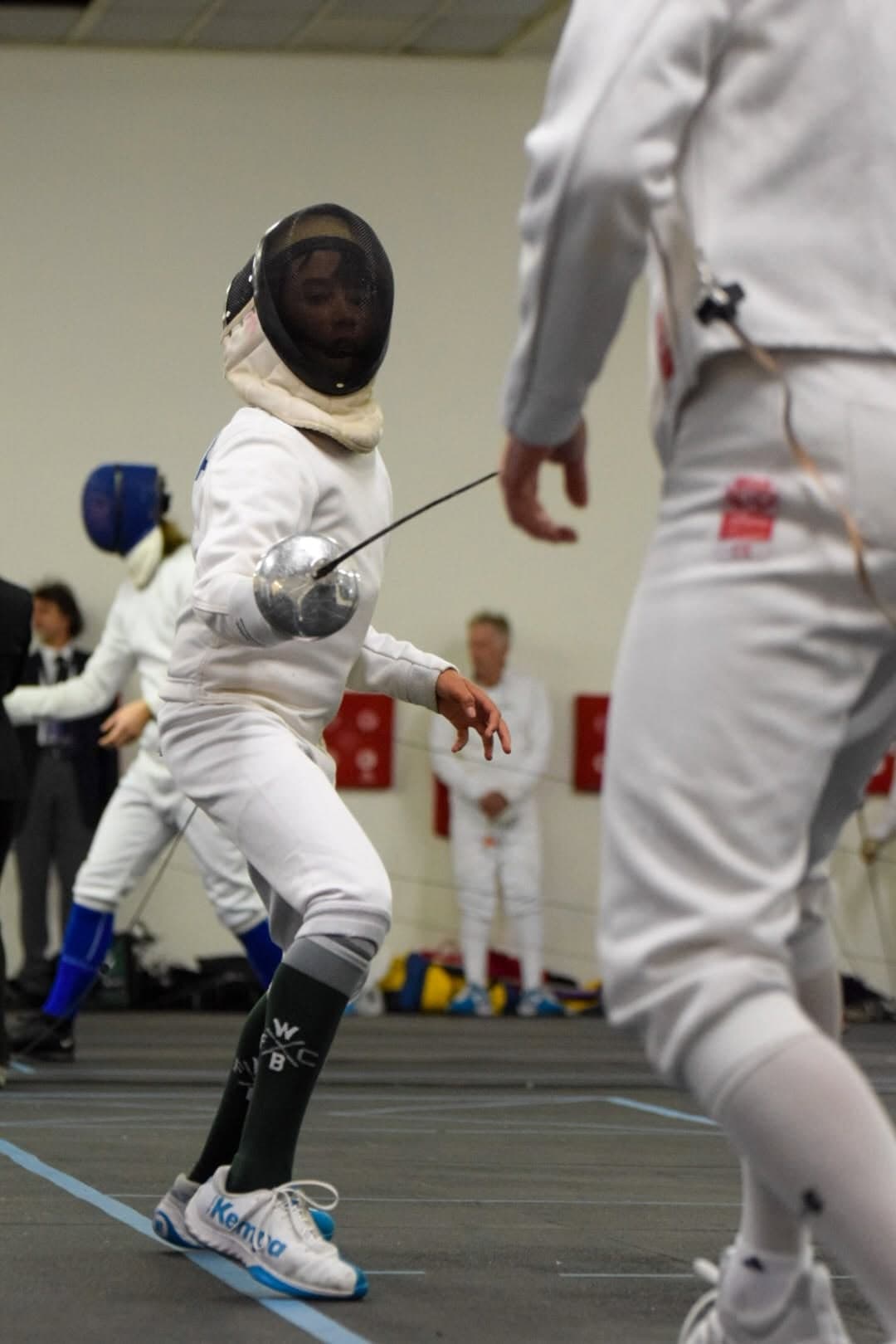
Competitive youth foil
The Four Patches
Earned, not bought — and deliberately hard.
Tiro, Prudens, Dominus and Magister. Each one asks for more than the last in three directions at once: what a fencer can do with the blade, what they have done in competition, and what they can do with their head when a bout turns.
- 1 of 4 · RecruitTiroNot a beginner's patch. A Tiro is a young competitive fencer who has shown discipline, composure and tactical awareness consistently over time, and who makes the club stronger while doing it.
- 2 of 4 · The thinking fencerPrudensThe thinking fencer. Prudens asks for a medal at a regional event or a D rating, and for a fencer whose attention has moved off their own footwork and onto the person in front of them.Standard being finalised
- 3 of 4 · Master of the boutDominusCommand of the bout, at national standard. Dominus asks for an A rating and either ten regional platforms or a national one — a fencer who imposes a game rather than playing someone else's.Standard being finalised
- 4 of 4 · MasterMagisterThe summit. Magister marks a first place at a national event and an A rating, and no MFA fencer has earned one — it exists to show where the road goes.Standard being finalised




One chart, four thresholds
Every badge is scored on the same seven categories. What rises is the mark required, and what a fencer must have done outside the salle to be eligible.
1
Technical Foundations
Strong en garde, balance, controlled advance and retreat, recovery after attacking, point control, safe blade mechanics, coordinated posture while moving, and reliance on strong fundamentals over reckless or low-percentage actions.
2
Distance, Timing & Tempo
Understands measure, intentionally enters and leaves distance, recognises unsafe distance, attacks with proper timing, notices rhythm changes, shows patience, understands basic tempo, and recognises when not to attack.
3
Blade Work & Tactical Awareness
Uses straight attack, disengage, feint, parry-riposte, circular parry and beat attack; recognises openings, notices opponent habits, fences with intention instead of guessing, and prioritises clean effective actions over flashy or uncontrolled ones.
4
Rules, Knowledge & Competitive Awareness
Understands right of way, valid target, off-target, corps-à-corps, cards, referee commands, pool and DE format, the salute, terminology, basic fencing history and culture, and equipment readiness.
5
Competitive Presence, Sportsmanship & Fun
Shows composure under pressure, respects referees, opponents and teammates, wins with humility, loses with dignity, encourages others, brings positive energy to practice, enjoys learning, is brave enough to try difficult things, and helps make fencing fun for everyone around them.
6
Commitment & Training Habits
Participates consistently in competitive classes, gives strong effort, listens to coaches, stays focused during drills, works hard even when training is difficult, and demonstrates discipline and responsibility.
7
Physical Readiness
Demonstrates athletic posture, coordination, agility, endurance through practice, recovery between bouts, explosive movement, and physical control while fencing.
The scale
- 1Beginning
- 2Inconsistent
- 3Developing
- 4Strong — badge ready
- 5Exceptional
Ongoing development
During the week, MFA coaches evaluate each fencer's progress across all of the categories above. These scores are not permanent grades.
They are a living reflection of growth, consistency, effort, discipline, sportsmanship and competitive development.
Progress charts are available online, so fencers and families can track improvement, identify strengths, understand areas for growth, and work steadily toward qualification.
The goal is continuous development over time — not perfection in a single day.
“The way is in training.”
Miyamoto MusashiGo Rin No Sho, 1645